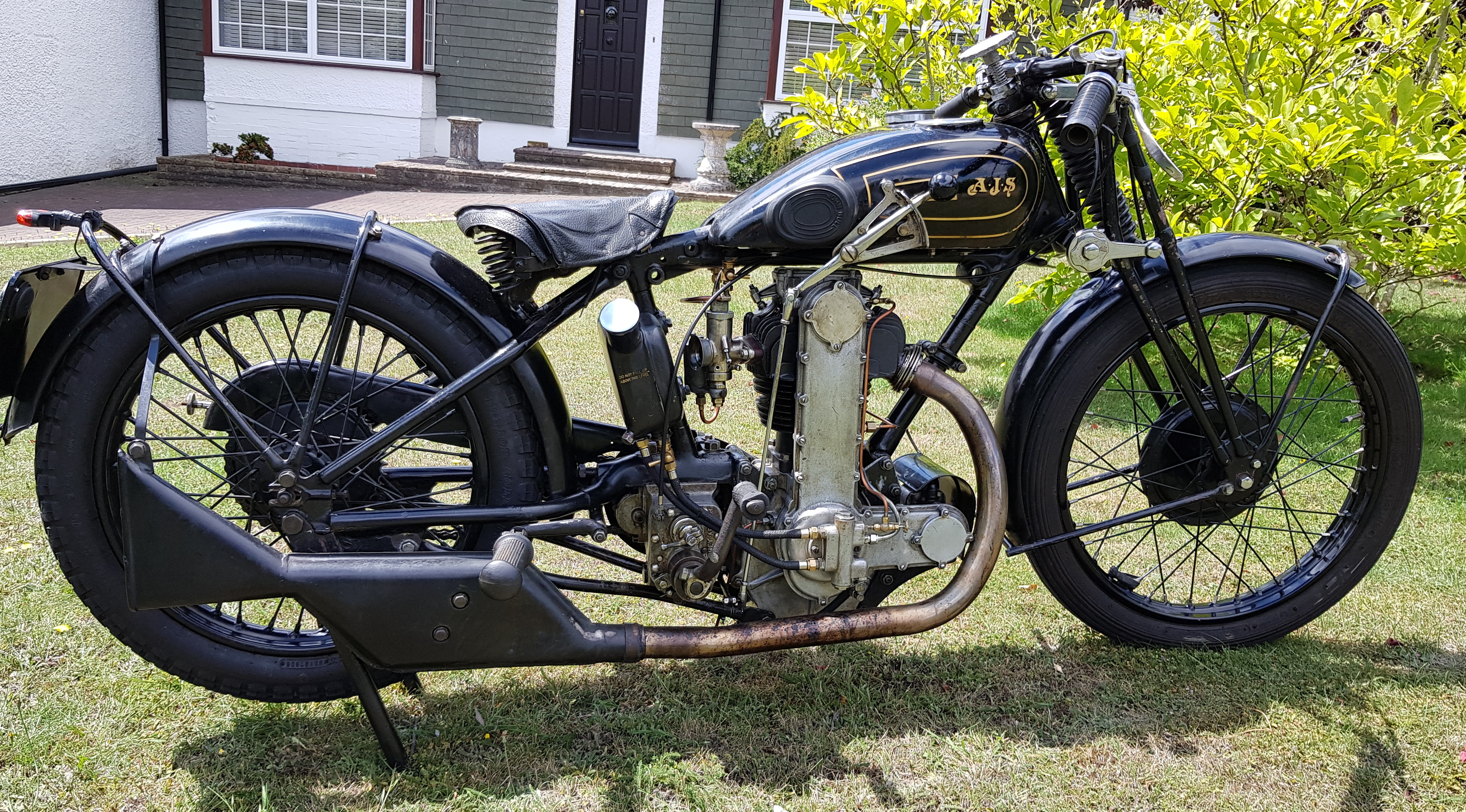
Although the engine was now bolted into the frame there were
numerous little jobs that needed to be completed. The original plan for this
bike was to build a regular road bike and I already had an engine lined up for
it. That engine has many new parts – crankshaft/conrod (manufactured by Alpha
Bearings), piston/rings in a Nikasil bore, valves/guides/springs/cam etc and
would have been pretty well identical to that of KTT 55 (see here and here for
example) but using standard “K” crankcases and barrel.
The acquisition of the DOHC engine changed that plan and the
originally-planned engine will now probably end up in an early Model K
flat-tanker at some time in the future. However, using the DOHC engine, it
seems more appropriate to build a race bike and it has ended up looking like
the two KTTs that I have just rebuilt although I have retained the 4-speed
gearbox and, slightly incongruously, the kickstart that was part of the 4-speed
‘box that I had already installed.
The dry build is now essentially finished
with only a couple of very minor jobs that will be done when
it is stripped for painting and plating.
However, it was quite a lot of work to complete the build after
the engine had been installed and there was a long list of parts that needed
either making or attaching:
- Left and right-side footrest support
stays (FK167 and FK167/2)
- Footrests (folding on the right side to
allow for the kickstart)
- Rear brake pedal fitment
- Rear wheel adjusters
- Chainguards
- Exhaust Pipe
- Attach carburettor float chamber
- Oil and Fuel lines
- Cambox oil scavenge
- Petrol tank filler cap
- Controls and cables
So, in no particular order….
Rear wheel adjusters
I don’t often use stainless steel but I have for these.
The same as on both KTTs.
Float Chamber
The float chamber needs the facility to adjust its height
relative to the carburettor to set the fuel level. Luckily, the left side rear petrol
tank securing bolt (5/16” BSW thread) is in pretty well the right place to be
able to position the float chamber immediately adjacent to the carb and so an
adjuster was made that both replaces the existing bolt and positions the float
chamber.
The upper thread on the central part is left hand and the
lower thread is right hand so that by loosening the locknuts the chamber can be
moved up or down easily with a spanner.
Footrest Support Stays, Footrests and Brake Pedal
The footrest support stays, FK-167 and FK-167/2 for the left
and right sides, are substantial. The ones that I have made here are direct
copies of the originals on KTT 55 and are 1 ¼” wide and ¼” thick. The picture
below shows them after bending to shape
but before footrests and other attachments have been added.
These require a lot of heat from the oxy-acetylene to be able to
bend them. Holes in the engine plates and spacers are also needed.
After adding the rest of the bits and pieces the whole
arrangement looks like this on the left side:
and, on the right side:
The folding footrest was one of a pair of pillion footrests
– the other one was used on the V-Twin which also has a kickstart. Rubbers will
come later after a visit to Jeff Hunters stall at one of the autojumbles.
Chainguards
The chainguards
were fitted following exactly the same practice as KTT 55,
described here.
Exhaust Pipe
I had a spare exhaust pipe that I had taken off KTT 305 (I
had replaced it with a full-length new one from Armours) but it was far too
short. However, the ID fitted over the exhaust stub on the aluminium cylinder
head like a glove and it was also a good shape. Luckily, I also had some
lengths of tube of the correct gauge and diameter to be able to extend it and
so an ~18” section was TIG welded onto the end and with clips from Armours, the
exhaust was fitted to the bike.
Short slits were put in the pipe where it clamps to the stub
on the cylinder head using a disc cutter.
Cambox Oil Scavenge
You may recall that my original plan for scavenging the oil
from the cambox was to allow the oil to drain back into the oil tank under
gravity. With the engine installed it was immediately apparent that the drain
point in the cambox was not high enough, relative to the oil tank, for that to
work.
Plan B: the oil can drain back into the crankcase via the
1/8” BSP threaded hole on the drive-side crankcase, however, the oil line will
now be subjected to the unattenuated cyclic pressure variations in the
crankcase. This can cause a problem - I have hit this before with both the AJcette
and the AJS V-Twin and the pressure oscillations can wreak havoc with any cambox
oil scavenging strategy.
Here, I have decided to use a one-way check valve that I had
acquired with a collection of Velo bits many years ago together with a plenum
to damp any stray pressure oscillations that would be transmitted to the cambox
– a bit belt-and-braces but straightforward to implement.
The check valve, which is referred to as a “disc valve” in
the Velo parts book, was fitted to certain “K” models and consists of an elbow
piece (K-184), a body and union (K-122 and K-136) and a steel disc (K-135), all
shown below.
Whoever designed this 90+ years ago at Veloce realised that
the inertia of the moving part – the disc – needed to be as small as physically
possible to be able to respond to the frequency of the pressure changes. The
dimensions of the disc are about 8mm diameter and 0.010” thick and this gives a
calculated mass of 0.1g; I doubt if it’s possible to design anything that is as
simple as this with equivalent functionality with less inertia. It’s works
perfectly with a simple “blow-suck” test by mouth; my lungs won’t operate at
the equivalent of 5000 rev/min so that is about all I can do to test it.
Now chemically blacked and fitted into the crankcase.
The plenum consists of a short length of steel tube (a bit
of exhaust pipe) and a couple of end-caps.
After silver soldering on the end caps and plumbing the
completed plenum assembly into the cambox-crankcase oil line, it fits snugly into
the engine layout.
Fuel Lines
There are quite a lot of connections between the petrol taps
> float chamber > carburettor and all of these have been made by silver
soldering short lengths of ¼” OD copper tube into brass nipples
and then connecting these with cloth-covered fuel line.
Oil Lines
Brass fittings were made for the feed and scavenge oil lines
and pipes were then bent to shape using pieces of fence wire to help in getting
the form correct.
An oil tap was fitted to avoid wet-sumping.
Interestingly, the oil tap, which is sold on ebay from many
sellers and, here, was sold under the banner “Classic Vintage Brass Petrol Oil
Tap”, came from Wuhan in China. I would assume that all of the identical taps
being sold are also made in China. It has been well made, has the correct BSP
threads and is excellent value at 7.24 GBP, including delivery. It also arrived
in the post just over a week after placing the order, which is pretty good
considering the distance it’s travelled.
The oil tank used on this bike is one of 2 that I had made
in India many years ago (copied from an original Model K tank) together with a
bunch of petrol tanks – I wrote about this back in 2021 – see here.
Here’s a picture of some of them. The petrol tank on the right side (one of 3
that were made) is fitted to this bike.
Fuel Filler Cap
Although I had a fuel filler cap of the correct size it
needed a fitting on the tank to attach it; I also found that the Viton seal was
too thick to allow insertion of the split-pin that holds it all together.
How to reduce the thickness of the seal? I don’t think I
have ever machined Viton before but I found that by mounting the seal on a
piece of tube (yet another use for short lengths of unused scrap exhaust pipe)
that a sharp tool and a fine cut would remove material without tearing or
ripping it
to allow it to fit properly onto the cap.
A small piece of sheet steel strip was bent to form the part
of the hinge that is attached to the filler on the tank and silver soldered in
place. With an M2.5 screw and dome nut the job is finished.
Cables and Controls
I always leave this job to last because it needs the
handlebars to be fitted and if these are put on too early, I end up banging my
head on the ends of the bars throughout the dry build.
Anyway, all the cables were made in the usual way – all nipples
are silver soldered
except the 2 nipples in the carburettor which are too small
and these are both soft soldered.
And Finally…..
Not everything goes according to plan.
To make the clutch cable I first remove the entire clutch
assembly – it’s a 2-minute job – and I then find it easier to set up the
various contacts between pins (3 in the clutch and 1 in the gearbox) and their
corresponding contacting surfaces to determine the length of the cable inner.
Although the gearbox and clutch had already been checked and rebuilt, I found
that the clutch thrust pin that is located in the gearbox (C-30) was too long
and I needed to remove about 0.030” from one end. To be able to access the pin
the Thrust Cup needs removing – all straightforward, however, in doing this,
one of the rollers of the new thrust bearing that I had put on fell out and
before I could find it the workshop fairies had it away ….never to be seen
again.

I must have spent more than an hour trying to find it and
eventually gave up. Luckily, these are standard size 3/16” x 3/16” rollers and
are both cheap and in plentiful supply – unlike the rollers used in the Harley
Davidson big-end assembly I used to build the AJS V-Twin crankshaft (see end of
thisblog). Anyway, waiting for the post to deliver some new rollers did allow
me some time to service the MG and mow the lawn.
The second little problem that I ran into was that a short,
scrap piece of old clutch cable
that I had retained in-situ in the gearbox fell out when I
removed the adjuster on the top of the ‘box and it disappeared down inside the
gearbox. I tried to get it out with a small telescopic magnet but that proved
fruitless. I didn’t really want to strip the gearbox again so ended up taking
the ‘box out of the bike and shaking it upside down and eventually managed to dislodge
the piece of cable from wherever it had ended up and I was then able to extract
it with long nosed pliers. C’est la vie.
And that concludes the dry builds of all 3 early cammies;
KTT 305 at the back, KTT 55 in the middle and the DOHC 250 leading the pack